Ever feel like pulling your hair out because you just aren’t getting sharp images? Sharpness in photography has always been one of the most important aspects of finished photos. Heck that is why a person can easily spend two, three, four times (sometimes even more) as much on a single lens as what was spent on the camera body it is going on. Millions of dollars are spent every year on development of professional sharpening software too. So what do you do when that special glass isn’t performing the way it should? There are a lot of factors that can contribute to this; let’s take a look at what those factors are and how to fix them.
Many times it is simply the camera settings which should be the first thing to always check and troubleshoot with. Camera diopters have been throwing even the most experienced photographers off for decades. Digital cameras have a lot of settings too, including sharpness and ISO. Setting a digital camera’s sharpness is something that can be a bit tricky; it is recommended that you keep it either on the factory default or not too far “out of range†of the default. Higher ISO’s (especially when combined with “noise reductionâ€) can have the effect of making your images look soft. If you have it set to “Auto ISO†and you were in any other lighting condition other than sunlight there is a good chance that is the culprit. If this is a “new†or “intermittent†issue that came on without provocation it is more likely to be a setting.
The other possibility is the lens and how the body is interacting with it. Assuming you’ve ruled out a dirty lens, this is the more interesting and agonizing possibility. Of course you may just have a cheap lens but even the newer consumer level lenses produced by major manufacturers (including third-party major manufacturers) should be fairly sharp. If, on the other hand, you feel it is not as sharp as it should be and particularly if you have what is considered to be a “Pro level†lens then you may want to try a couple of things yourself to test it. Commonly it is a front or back focusing issue. Diagnosing takes a tripod and a few objects to focus on that is on a well lit plane that are easy to single out (objects on a cleared desk/countertop works well). It should be pretty clear if it is front or back focusing or it may just be soft.
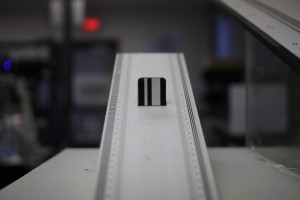
What can be done when the camera and lens are front, back or soft focusing? Calibration is what needs to be done. Most commonly, adjustments are done on the lens since there are more noticeable variations that exist on them and there are more adjustments that can be made. Most lenses today are calibrated using manufactures adjustment software. Some older lenses may have a series of solder points that when bridged in the correct sequence will provide the proper calibration. Bodies are also calibrated using adjustment software. Calibration on a lens is done using a slope chart (pictured at the top); a known “good†body is used with the lenses F-stop set wide open for the narrowest depth of field. If you are interested in the technical details, front focus is considered to be (-) minus, meaning the point of focus is in front of the target on the slope chart; and back focus is considered (+) plus, meaning the point of focus is behind the target. Measurements are taken at both telephoto and wide angle ranges of zoom lenses. The same procedure for camera bodies is done using a known “good†lens.
When that has been done and you are still having focus issues there is one other thing that can be done. You can have lens calibrated to the camera body. It is best to calibrate the lens to your body because of other lenses you may own. It is important to note that since each body and lens has their own unique adjustment, once calibration is done this could affect optimal focus of them when used with other units.